
Quick Summary
Introduction
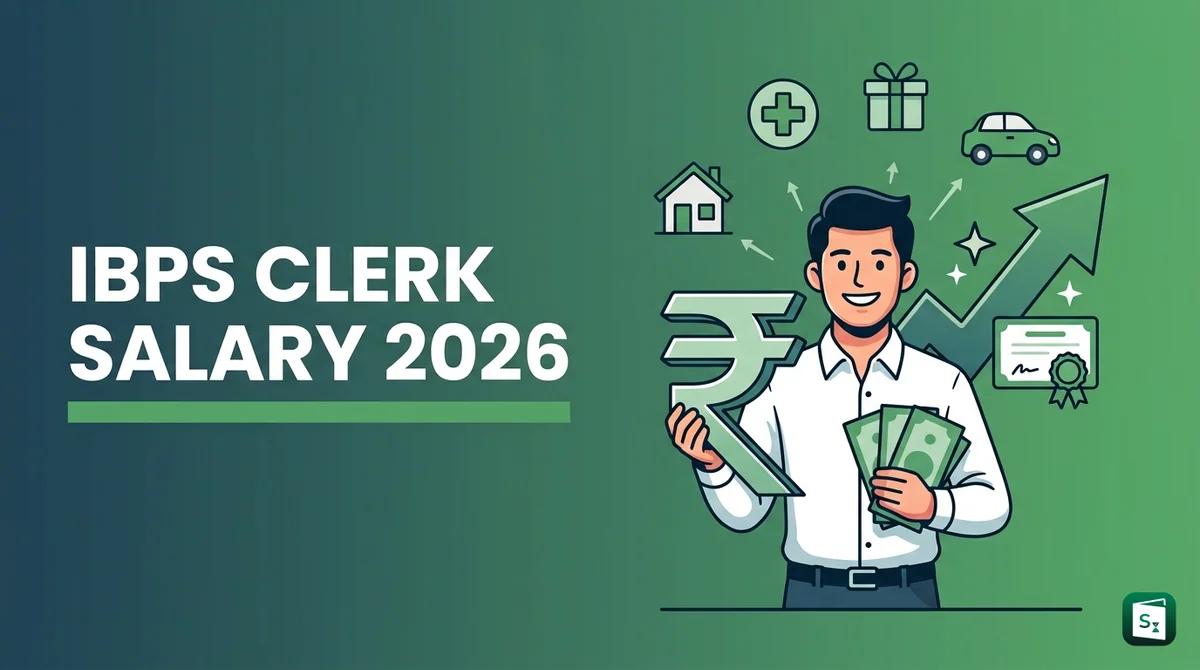
If you are preparing for the IBPS Clerk exam in 2026, your first question is usually about salary. How much will you actually take home after the new pay revision? The IBPS Clerk Salary 2026 has changed significantly after the 12th Bipartite Settlement. The starting basic pay is now ₹24,050 instead of the old ₹19,900 that many websites still show. With allowances, the gross salary is around ₹43,500 to ₹46,300 and the final in-hand salary is roughly ₹39,800 to ₹42,500 depending on your city of posting.
This guide gives you the complete picture. You will learn the official pay scale of ₹24,050 to ₹64,480, the full salary breakdown with Dearness Allowance, House Rent Allowance and Special Allowance, city-wise differences between metro and rural postings, and why older sources show the wrong basic pay. You will also understand what a Customer Service Associate actually does every day, whether you can get a posting near your hometown, what the working hours look like, and how fast you can grow from Clerk to Officer and beyond. By the end, you will know exactly what to expect from the job reality and career ladder of an IBPS Clerk.
IBPS Clerk Salary: Highlights
Here is a quick overview of the revised compensation for Customer Service Associates in participating public sector banks.
| Particulars | Details |
|---|---|
| Post Name | Customer Service Associate (CSA), earlier called IBPS Clerk |
| Recruiting Body | Institute of Banking Personnel Selection (IBPS) |
| Participating Banks | 11 public sector banks including Bank of Baroda, Canara Bank, Punjab National Bank and others |
| Starting Basic Pay | ₹24,050 |
| Pay Scale | ₹24,050 to ₹64,480 |
| Gross Monthly Salary | Around ₹43,500 to ₹46,300 at joining |
| In-Hand Monthly Salary | Around ₹39,800 to ₹42,500 after deductions |
| Maximum Basic Pay | ₹64,480 after 20 years of increments |
| Posting Basis | State or Union Territory wise |
| Pension Scheme | National Pension System (NPS) |
This structure comes from the 12th Bipartite Settlement signed between the Indian Banks’ Association and employee unions. It applies equally to all 11 IBPS participating banks listed in the official CRP CSA XVI notification for 2027 to 28 vacancies. Your take-home pay does not depend on which bank you get, it depends on where you are posted and when you joined. For official dates, exam pattern and vacancies, see our IBPS Clerk Notification 2026.
Pay Scale After 12th BPS
Many old articles still show the pay scale starting at ₹19,900. That was the 11th Bipartite scale. The official CRP CSA XVI notification confirms the revised scale after the 12th Bipartite Settlement.
The pay scale is:
₹24,050 - 1340/3 - 28070 - 1650/3 - 33020 - 2000/4 - 41020 - 2340/7 - 57400 - 4400/1 - 61800 - 2680/1 - 64480
This notation looks complex. It simply shows how your basic pay grows with fixed annual increments over 20 years.
| Stage | Service Period | Annual Increment | Basic Pay at End of Stage |
|---|---|---|---|
| Starting | Day 1 | None | ₹24,050 |
| Stage 1 | Next 3 years | ₹1,340 per year | ₹28,070 |
| Stage 2 | Next 3 years | ₹1,650 per year | ₹33,020 |
| Stage 3 | Next 4 years | ₹2,000 per year | ₹41,020 |
| Stage 4 | Next 7 years | ₹2,340 per year | ₹57,400 |
| Stage 5 | Next 1 year | ₹4,400 per year | ₹61,800 |
| Stage 6 | Final 1 year | ₹2,680 per year | ₹64,480 |
What this means for you:
- After 3 years, your basic reaches ₹28,070.
- After 6 years, it reaches ₹33,020.
- After 10 years, it reaches ₹41,020.
- After 20 years, you hit the maximum basic of ₹64,480.
Note: This scale is for IBPS Clerks. SBI Clerks look similar but start higher at ₹26,730 because graduates get two advance increments. IBPS does not give those advance increments. For a detailed comparison, read our SBI Clerk Salary 2026.
Every time your basic pay increases, Dearness Allowance and House Rent Allowance also increase automatically because they are calculated as a percentage of basic pay.
Salary Breakdown and Gross Pay
Your monthly gross salary is the sum of basic pay and several allowances. Here is the realistic breakdown for a newly joined IBPS Clerk in 2026 based on the 12th Bipartite structure.
| Component | Amount (Approx.) | What it Means |
|---|---|---|
| Basic Pay | ₹24,050 | Fixed pay on which all other allowances are calculated |
| Dearness Allowance (DA) at 19.83% | ₹4,769 | Paid to offset inflation, linked to Consumer Price Index and revised every quarter |
| Special Allowance | ₹7,083 | Fixed allowance introduced under the settlement, also attracts DA |
| DA on Special Allowance | ₹1,405 | Dearness Allowance calculated on Special Allowance at the same rate |
| House Rent Allowance (HRA) | ₹1,737 to ₹2,740 | Depends on city type, 6.5% to 9% of basic plus special pay |
| Transport Allowance (TA) | ₹850 | Fixed amount for daily travel |
| DA on Transport Allowance | ₹169 | Small DA component on transport allowance |
| Gross Salary | ₹40,200 to ₹46,300 | Total before deductions |
Exact gross varies because HRA and Transport Allowance differ by posting location. The lower gross figure applies to rural and other areas, the higher figure applies to metro cities.
Deductions from Gross Salary
Gross salary is not your take-home pay. The following amounts are deducted each month:
| Deduction | Amount (Approx.) |
|---|---|
| NPS Contribution (10% of basic plus DA) | ₹2,850 to ₹3,750 |
| Professional Tax (varies by state) | ₹150 to ₹208 |
| Union subscription and welfare funds | ₹150 to ₹250 |
| Total Deductions | ₹3,100 to ₹4,200 |
The National Pension System, or NPS, is the retirement scheme for bank employees. Both you and the bank contribute. Your share is deducted from salary, the bank adds its own contribution, and the amount grows till retirement. Contributions are eligible for tax benefit under Section 80C.
In-hand salary = Gross salary minus total deductions
At joining, this works out to roughly ₹37,700 in other areas, ₹40,400 in urban areas, and ₹42,000 to ₹42,500 in metro cities. Many sites quote a single figure of around ₹39,000 to ₹40,000, which is the average across locations after deductions.
In-Hand Salary: City Wise
HRA, or House Rent Allowance, is the main reason your in-hand salary changes with posting location. It is calculated as a percentage of basic pay.
- Metro cities (X class): 9% of basic pay. Cities like Mumbai, Delhi, Chennai, Kolkata, Bengaluru and Hyderabad.
- Urban cities (Y class): 7.5% to 8% of basic pay. State capitals and large district headquarters like Pune, Jaipur, Lucknow, Patna, Ahmedabad.
- Other areas (Z class and rural): 6.5% of basic pay. Smaller towns and semi-urban branches.
City Compensatory Allowance and Transport Allowance also vary slightly between these classes.
| Component | Metro (X Class) | Urban (Y Class) | Other Areas (Z/Rural) |
|---|---|---|---|
| Basic Pay | ₹24,050 | ₹24,050 | ₹24,050 |
| DA at 19.83% | ₹4,769 | ₹4,769 | ₹4,769 |
| Special Allowance | ₹7,083 | ₹7,083 | ₹7,083 |
| DA on Special Allowance | ₹1,405 | ₹1,405 | ₹1,405 |
| HRA | ₹2,740 (9% approx.) | ₹2,100 (7.5% approx.) | ₹1,737 (6.5%) |
| Transport Allowance with DA | ₹1,019 | ₹850 | ₹600 |
| Gross Salary | ₹41,000 to ₹46,300 | ₹40,200 to ₹44,600 | ₹39,600 to ₹43,500 |
| Deductions (NPS, tax, union) | ₹3,700 to ₹4,200 | ₹3,500 to ₹3,900 | ₹3,200 to ₹3,700 |
| In-Hand Salary | ₹41,000 to ₹42,500 | ₹39,500 to ₹40,800 | ₹37,700 to ₹39,800 |
The gap between a metro posting and a rural posting is about ₹2,500 to ₹3,000 per month at the starting level. Over time, the gap widens as increments push HRA higher in metros.
For SBI, the metro in-hand can reach ₹42,584 because its starting basic is higher at ₹26,730 including two advance increments for graduates. IBPS does not offer those two increments, so its in-hand is slightly lower at joining. Check our detailed SBI Clerk Salary 2026 for the direct comparison.
Why Many Sites Still Show ₹19,900
If you search today, you will still find pages that say the IBPS Clerk basic is ₹19,900 and in-hand is ₹29,000 to ₹31,000. Those figures belong to the 11th Bipartite Settlement.
- The old scale was ₹19,900 - 1000/1 - 20900 - 1230/3 - 24590 - 1490/4 - 30550 - 1730/7 - 42600 - 3270/1 - 45930 - 1990/1 - 47920.
- The new scale under the 12th Bipartite is ₹24,050 to ₹64,480.
- The hike was about 17% including a 3% load factor, effective from 1 November 2022.
Search results that have not been updated still copy the 11th BPS numbers. The official CRP CSA XVI notification dated 1 August 2026 clearly lists the new scale. Always verify salary information against the official IBPS notification, not against old blog posts.
Some other sources also mistakenly show ₹17,900 as the new basic. That figure comes from a misreading of the DA merge calculation on some portals. The correct starting basic for a Customer Service Associate is ₹24,050.
Perks and Benefits Beyond Salary
Salary is only part of the IBPS Clerk compensation. The following benefits add real value and are common across all participating banks, though exact limits depend on the individual bank’s rules.
| Benefit | Details |
|---|---|
| Medical Coverage | Reimbursement for self and dependents, usually with an annual ceiling. Some banks also offer group mediclaim |
| Leave Benefits | Casual leave, privilege leave, sick leave, maternity and paternity leave as per bipartite rules |
| Leave Fare Concession | Reimbursement for travel during leave to hometown or anywhere in India once every year or two years |
| Concessional Loans | Housing, vehicle and personal loans at lower interest rates than offered to customers. This can save lakhs over a career |
| Pension | Monthly contribution to NPS for long term retirement corpus |
| Allowances | Newspaper, cleaning and other small reimbursements depending on the bank |
These benefits are why the clerical cadre is considered stable. Even though the basic salary is lower than officer posts, the loan concessions and job security make the overall package attractive.
IBPS Clerk Job Profile
An IBPS Clerk is now officially called Customer Service Associate (CSA) since April 2024. You are the first person a customer meets at the branch. Your work is a mix of counter operations, documentation and back-office support.
Daily Duties at the Branch
- Handle cash counter operations including deposits, withdrawals and cash balancing
- Receive cheques, demand drafts, pay orders and dividend warrants and process them for clearing
- Open new accounts, close accounts, update Know Your Customer (KYC) details and verify documents
- Update passbooks, print account statements, issue cheque books, debit cards and demand drafts
- Attend to customer queries at the inquiry counter and guide customers on government schemes, digital banking and account procedures
- Perform data entry in the Core Banking System (CBS), maintain ledgers and reconcile daily cash
- Handle mail, delivery of cheque books, and maintain important keys, documents and cash under joint custody
- Support officers in treasury work, audit preparation and end-of-day reports
A clerk in a busy urban branch may handle 100 or more customer transactions a day. In a rural branch with fewer staff, the same clerk may handle a wider mix of tasks from front desk to back office.
Single Window Operator Role
Most clerks work as a Single Window Operator. This means you handle all routine customer-facing work from one counter, from cash to passbook to account opening, without the customer needing to move between desks.
Your authority is limited compared to officers. You do not sanction loans or take credit decisions. Your role is operational and service focused.
For eligibility including education, age and local language requirements, see our IBPS Clerk Eligibility 2026.
Posting and Transfer Policy
Getting a posting near your hometown is the biggest concern after salary. IBPS Clerk recruitment is state wise, which helps compared to officer posts that have all-India transfers.
How Posting Is Decided
- You can apply for vacancies in only one state or Union Territory. The state you choose in the application is where you will be posted. This choice is irrevocable after the edit window closes.
- Provisional allotment is done on a merit cum preference basis based on your Main exam score, your bank preference list and vacancies reported by banks for that state.
- Your exact branch, whether urban, semi-urban or rural, is decided by the allotted bank based on business needs, vacancy in that district and administrative requirements.
- There is no guarantee of a specific city or district within the state, even if you applied from that state.
You must also be proficient in reading, writing, speaking and understanding the local language of the state you apply for. Banks conduct a Local Language Proficiency Test after the Main exam and before joining. If you fail this test or cannot produce a Class 10 certificate showing you studied the language, you are disqualified.
Can You Get Home Posting?
- Since posting is within the state, there is a good chance of being posted in or near your home district, especially if the allotted bank has many branches there.
- Home city posting is not promised. Candidates from states with many vacancies like Uttar Pradesh, Maharashtra and Karnataka often get a district nearer to home. Candidates from states with fewer vacancies may be posted farther within the same state.
- Female candidates often get preference. Married women are usually considered for posting close to their spouse’s residence, and unmarried women close to their parents’ residence, as per bank-wise staff welfare guidelines. This is a priority consideration, not a guarantee.
- If you are posted far from your hometown, you can apply for a transfer later under the bank’s internal transfer policy. Transfers for clerks are generally considered only within the same state or circle after completing a minimum service period of 2 to 3 years. Inter-state transfers for clerks are rare and depend on the individual bank.
Tip: Choose your application state based on language proficiency and realistic home proximity, not just total vacancies. Applying to a state where you do not know the local language risks disqualification in the proficiency test.
Working Hours and Balance
The clerk cadre is often chosen for its relatively stable work-life balance compared to officer roles.
- Working hours: Generally 10 am to 5 pm on working days, with a lunch break usually between 1.30 pm and 2.30 pm. Actual timings can stretch to 6 pm during heavy days.
- Working days: Banks work six days a week except the 2nd and 4th Saturdays and all Sundays, which are holidays. So you work on the 1st, 3rd and 5th Saturdays.
- After-hours work: During month end, financial year closing, audits or heavy customer rush, clerks may stay beyond regular hours to complete reconciliation and reports. The extension is usually manageable.
- No night shifts: This is a day shift role with no rotating roster.
Is the Work Stressful Compared to PO and SBI Clerk?
- Compared to an IBPS PO, the clerk role has lower pressure. Clerks have defined operational duties, while Probationary Officers handle targets, credit decisions, recovery and late sitting for closing and reporting.
- Compared to SBI Clerk, the workload is broadly similar because both follow the same bipartite pay and similar branch operations. SBI branches often have higher customer footfall, so SBI Clerks in busy urban branches may face slightly more transaction load. Some smaller public sector banks in rural areas have lighter footfall.
Overall, the workload is moderate and predictable for most branches. Urban branches with 500 to 700 transactions a day feel busier than rural branches, but the cadre is known for more regular hours than officer roles.
Promotion and Career Growth
Joining as a Clerk is not a dead end. Public sector banks have a clear promotion hierarchy and two tracks to reach officer level.
How Fast Can You Become an Officer?
You become eligible for promotion after a minimum service period. The fastest route uses professional qualifications.
| Promotion Channel | Eligibility | Process |
|---|---|---|
| Merit or Fast Track | Minimum 3 years as Clerk plus JAIIB and CAIIB diplomas from Indian Institute of Banking and Finance | Bank internal written exam and interview, then promotion to Trainee Officer. After 2 years probation, you become a Probationary Officer, which is Junior Management Grade Scale 1 |
| Normal or Seniority Track | Minimum 6 years without JAIIB/CAIIB, or about 12 years in some banks under normal channel | Internal exam based on experience and seniority, without compulsory JAIIB/CAIIB in some banks |
JAIIB stands for Junior Associate of Indian Institute of Bankers. CAIIB stands for Certified Associate of Indian Institute of Bankers. These are banking diplomas that give you extra increments and make you eligible for faster promotion. Many clerks start preparing for JAIIB from the first year itself to become eligible at the 3-year mark.
Hierarchy from Clerk to General Manager
Customer Service Associate (Clerk), then Officer / Assistant Manager (Scale 1), then Manager (Scale 2), then Senior Manager (Scale 3), then Chief Manager (Scale 4), then Assistant General Manager (Scale 5), then Deputy General Manager (Scale 6), then General Manager (Scale 7)
Each promotion brings a jump in basic pay. For reference, Officer Scale 1 basic starts at around ₹48,480, roughly double the Clerk starting basic, with correspondingly higher allowances and gross.
While promotions are conducted periodically, they are not automatic. They depend on service length, vacancies, performance appraisal and clearing internal exams. Once promoted to the officer cadre, all-India transfer rules may apply, unlike the state-bound clerical cadre where transfers stay largely within the state.
IBPS Clerk vs SBI Clerk Salary
Many aspirants prepare for both exams. The pay scales now overlap, but there is still a gap at joining due to SBI’s advance increments.
| Parameter | IBPS Clerk (CSA) | SBI Clerk (Junior Associate) |
|---|---|---|
| Starting Basic Pay | ₹24,050 | ₹26,730 including 2 advance increments for graduates |
| Pay Scale | ₹24,050 to ₹64,480 | ₹24,050 to ₹64,480 |
| Gross Monthly (Metro) | ₹43,500 to ₹46,300 | ₹46,000 to ₹46,329 |
| In-Hand Monthly (Metro) | ₹39,800 to ₹42,500 | ₹42,000 to ₹42,584 |
| Leased Accommodation | Generally not offered at clerk level | Available in many SBI circles, worth ₹5,000 to ₹15,000 |
| Posting | Across 11 public sector banks, state wise | Only within SBI circles, state wise |
Why SBI pays slightly more at start: The two advance increments raise its basic from ₹24,050 to ₹26,730, and DA, HRA and Special Allowance are calculated on this higher figure. Over time, with annual increments, the gap narrows.
Where IBPS has an edge: You get a choice of 11 banks and your allotment is merit cum preference within one state, which many candidates feel improves home posting chances. Workload can also be lighter in smaller public sector banks compared to high footfall SBI branches.
For a complete breakdown of SBI allowances, deductions and city-wise salary, read our SBI Clerk Salary 2026 guide.
Official & Helpful Links
What to do next?
You now know the complete IBPS Clerk Salary 2026 reality after the 12th Bipartite Settlement, from the official basic pay of ₹24,050 and gross of up to ₹46,300 to city-wise HRA differences, daily duties as a Customer Service Associate, state-wise posting rules and the promotion path to officer through JAIIB and CAIIB.
Here is what to do next:
- Verify your state choice and eligibility. Confirm your age, graduation status and local language proficiency for the state you will apply to. One wrong state choice can cost you the job in the language test. Check our IBPS Clerk Eligibility 2026 and IBPS Clerk Notification 2026 before you apply.
- Plan for allowances, not just basic pay. If home posting is your priority, compare banks with more branches in your district within your state. Remember that metro posting adds about ₹2,500 to ₹3,000 in HRA but also higher living costs.
- Start scoring where others lose marks. While everyone practices Quant and Reasoning, selection is often decided in Current Affairs and English. While everyone focuses on aptitude, smart aspirants know the selection happens in Current Affairs and English. Build a daily habit now.
- Use exam-focused resources. For complete understanding, use the Scoreclever Current Affairs Website for detailed daily coverage and download the crisp daily Banking and SSC Plus PDFs from Scoreclever’s Telegram channel. You can verify coverage with our performance reports. For vocabulary and fact retention, the Scoreclever App schedules revisions automatically so you do not forget what you learn. Test yourself daily in the Vocab League at 7 PM and Current Affairs League at 8 PM.
- Start thinking about promotion early. If you want to become an officer in 3 years instead of 6, plan to clear JAIIB and CAIIB soon after joining. This single decision can double your basic pay early in your career.