
Quick Summary
Introduction
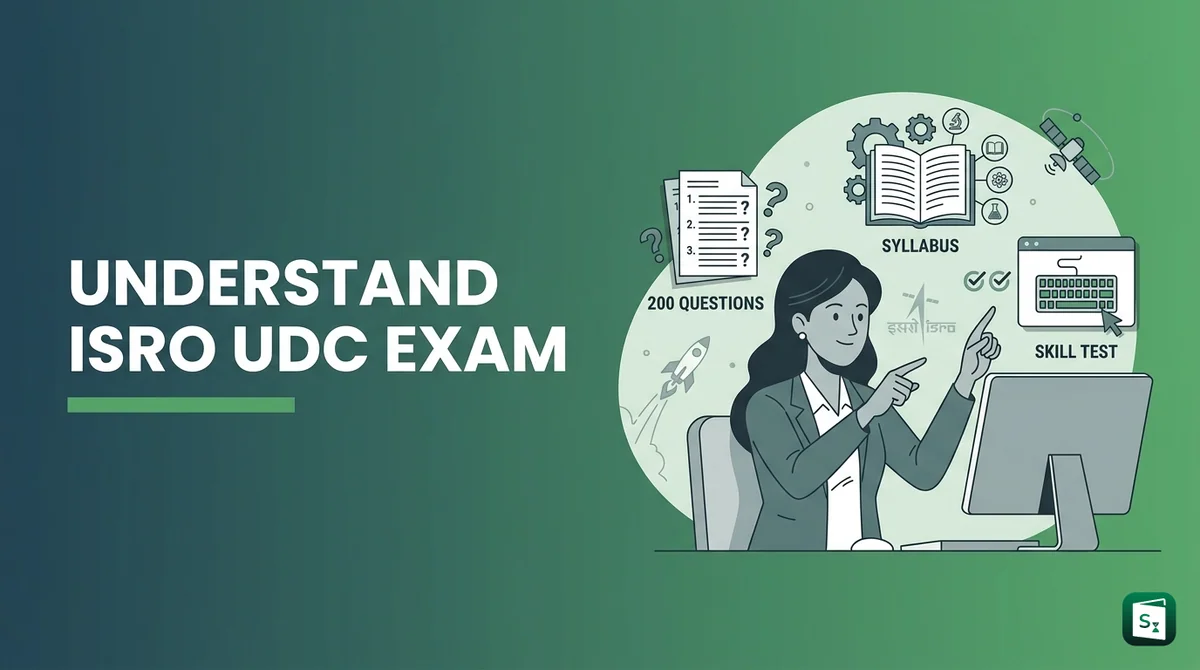
The ISRO Assistant UDC exam pattern 2026 is unlike the typical SSC or banking exam structure that most aspirants are familiar with. With 200 objective-type questions packed into a single 150-minute paper, equal weightage across four sections, and a separate skill test stage, the Indian Space Research Organisation (ISRO) tests candidates on a broader and more balanced set of skills. If you are preparing for the ISRO Recruitment 2026 (Advt No. ISRO:ICRB:01(A-JPA):2026), understanding the exact exam pattern, syllabus breakdown, marking scheme, and skill test criteria is the first step toward a focused preparation strategy.
In this article, you will get the complete ISRO Assistant UDC exam pattern 2026, including section-wise question distribution, subject-wise syllabus topics, how the pattern differs from JPA and Stenographer posts, the computer literacy test format, stenography test details, qualifying marks for each stage, and how ISRO prepares its final merit list.
ISRO Assistant UDC Exam Pattern 2026: Key Highlights
The ISRO recruitment exam for Assistant and UDC posts follows a straightforward but demanding structure. Here is the snapshot of the complete exam pattern:
| Particulars | Details |
|---|---|
| Advt. No. | ISRO:ICRB:01(A-JPA):2026 |
| Mode of Exam | Online (Computer Based Test) |
| Type of Questions | Objective (Multiple Choice) |
| Total Questions | 200 |
| Total Marks | 200 |
| Duration | 150 Minutes |
| Marking Scheme | +1 for each correct answer |
| Negative Marking | 0.25 marks deducted per wrong answer |
| Subjects | General English, Quantitative Aptitude, General Intelligence and Reasoning Ability, General Knowledge |
| Skill Test | Computer Literacy Test (qualifying nature) |
The exam is a single paper with four equal sections. Each section carries 50 questions for 50 marks, making the total 200 questions for 200 marks. This equal distribution means you cannot afford to ignore any section. Unlike banking exams where English or Quant often carries higher weightage, ISRO treats all four subjects identically.
The 150-minute duration for 200 questions gives you roughly 45 seconds per question. This is tighter than most banking exams but manageable with practice. The negative marking of 0.25 marks per wrong answer adds a layer of strategy. Guessing randomly is not a good approach here since each wrong answer costs you one-fourth of a mark.
Written Test Pattern for Assistant and UDC
The written test is the first and most important stage of the ISRO selection process. It is a single objective-type paper conducted online at test centres across India. The exam tests candidates across four broad areas. Here is the complete section-wise breakdown:
Section-wise Question Distribution
| Part | Subject | No. of Questions | Marks |
|---|---|---|---|
| A | General English | 50 | 50 |
| B | Quantitative Aptitude | 50 | 50 |
| C | General Intelligence and Reasoning Ability | 50 | 50 |
| D | General Knowledge | 50 | 50 |
| Total | 200 | 200 |
Each section is a separate part of the same paper. There is no sectional time limit, which means you can allocate your time across sections based on your strengths. However, the equal weightage of 50 questions per section means skipping or under-preparing any one section can cost you significantly.
Some sources mention the duration as 120 minutes while others say 150 minutes. The official notification for the 2026 cycle (Advt No. ISRO:ICRB:01(A-JPA):2026) specifies 150 minutes for the written test. PwBD candidates receive compensation time as per government norms.
Marking Scheme and Negative Marking
The marking scheme is simple but the negative marking demands a careful approach:
- Correct answer: +1 mark
- Wrong answer: 0.25 marks deducted
- Unattempted question: 0 marks
Here is what this means in practice. If you attempt all 200 questions and get 150 right and 50 wrong, your score would be 150 minus 12.5, which equals 137.5. But if you skip 50 questions you are unsure about and only attempt 150, getting 140 right and 10 wrong gives you 140 minus 2.5, which equals 137.5. The math shows that careful attempt strategy matters more than attempting everything.
Smart tip: Only attempt questions where you can eliminate at least one or two options. Blind guessing across 200 questions can easily pull your score down.
ISRO Assistant UDC Syllabus 2026
Knowing the exam pattern is only half the battle. The real preparation starts when you understand what topics fall under each section. The official notification provides an indicative syllabus for each subject. Here is a detailed breakdown:
General English
The General English section tests your understanding and knowledge of the language along with your ability to write correctly, precisely, and effectively. The topics covered include:
- Grammar rules and usage
- Vocabulary and word meanings
- Antonyms and synonyms
- Idioms and phrases
- Sentence formation and correction
- Reading comprehension
- Correct usage of words
- Fill in the blanks
- Error spotting
- Para jumbles
This section carries 50 questions and is one of the highest scoring areas for candidates with a strong English foundation. Focus on grammar fundamentals, commonly tested idioms, and reading comprehension practice.
Quantitative Aptitude
The Quantitative Aptitude section is comprehensive and covers a wide range of mathematical topics. The important areas include:
- Number System: LCM and HCF, simplification, surds and indices
- Arithmetic: Percentages, profit and loss, discount, ratio and proportion, average, mixture and allegation
- Interest: Simple interest and compound interest
- Time and Work: Pipes and cisterns, boats and streams, partnerships
- Time, Speed and Distance: Trains, relative speed
- Algebra: Factorisation, polynomials, sequence and series, linear equations, algebraic identities
- Geometry: Triangles, circles, quadrilaterals, lines and angles
- Mensuration: Area, perimeter, volume of 2D and 3D shapes
- Trigonometry: Trigonometric identities, ratios, heights and distances, circular measures
- Data Interpretation: Charts, tables, graphs
- Statistics: Basic statistical measures
With 50 questions, this section demands both speed and accuracy. Practice shortcut methods for percentage, ratio, and time-speed-distance problems to save time during the exam.
General Intelligence and Reasoning Ability
This section tests your logical and analytical thinking through both verbal and non-verbal type questions. The key topics are:
- Number series and repeated series
- Analogy (verbal and non-verbal)
- Coding and decoding
- Venn diagrams
- Logical arrangement of words
- Sitting arrangement (linear and circular)
- Ranking arrangement
- Dice, cube and cuboid
- Calendar and clock problems
- Direction sense
- Counting figures
- Problems based on alphabets
- Mirror image and water image
- Coded equations
- Missing number problems
- Figure-based sequence and pattern
Reasoning is one section where consistent practice directly translates to higher scores. Start with easier topics like analogy, coding-decoding, and series, then move to complex ones like sitting arrangement and calendar.
General Knowledge
The General Knowledge section tests your awareness of the environment around you and its applications to society. It covers both static GK and current affairs. The topics include:
- Current Affairs: National and international importance events
- Indian History: Ancient, medieval, and modern India
- Geography: Indian and world geography
- Indian Polity: Constitution, governance, political system
- Indian Economy: Budget basics, economic schemes, banking terms
- Science and Technology: General science, space, IT developments
- Indian Culture: Art, literature, festivals, heritage
- Environment: Ecology, conservation, environmental issues
- Important Government Schemes: Current flagship schemes
Since this is an ISRO recruitment exam, stay updated on India’s space missions, satellite launches, and scientific achievements. ISRO-specific current affairs often appear in this section. Follow daily current affairs and revise monthly compilations to keep facts fresh in memory.
How ISRO Assistant UDC Pattern Differs from JPA and Stenographer
One of the most important things to understand about ISRO Recruitment 2026 is that the written test pattern is not the same for all posts. The exam structure changes depending on whether you are applying for Assistant/UDC or JPA/Stenographer. Here is a side-by-side comparison:
| Particulars | Assistant/UDC (Post 1, 3, 5) | JPA/Stenographer (Post 2, 4, 6) |
|---|---|---|
| Mode of Exam | Online | Online |
| Type of Question | Objective (MCQ) | Objective (MCQ) |
| Total Questions | 200 | 200 |
| Total Marks | 200 | 200 |
| Duration | 150 Minutes | 150 Minutes |
| Negative Marking | 0.25 per wrong answer | 0.25 per wrong answer |
| Section Distribution | ||
| Part A | General English (50Q/50M) | English Language and Comprehension (100Q/100M) |
| Part B | Quantitative Aptitude (50Q/50M) | General Intelligence and Reasoning (50Q/50M) |
| Part C | General Intelligence and Reasoning (50Q/50M) | Quantitative Aptitude and General Knowledge (50Q/50M) |
| Part D | General Knowledge (50Q/50M) | Not applicable |
The key differences are:
For Assistant/UDC: The paper has four equal sections of 50 questions each. General English, Quantitative Aptitude, Reasoning, and General Knowledge all carry equal weightage. This is a balanced pattern that tests breadth of knowledge.
For JPA/Stenographer: The paper has only three sections, but English Language and Comprehension gets a massive 100 questions (double the weightage). Quantitative Aptitude and General Knowledge are combined into one section of 50 questions. This pattern heavily favours candidates with strong English skills.
If you are applying for both Assistant/UDC and JPA/Stenographer, you need to prepare differently for each. The JPA/Stenographer paper rewards English proficiency far more than the Assistant/UDC paper does. Similarly, the JPA/Stenographer paper does not have a separate Reasoning section, which means your reasoning practice serves a different purpose there.
The Skill Test also differs. For Assistant/UDC, you only appear for the Computer Literacy Test. For JPA/Stenographer, you appear for both the Computer Literacy Test and a Stenography Test.
Skill Test for Assistant and UDC: Computer Literacy Test
Candidates who qualify the written test are shortlisted for the Skill Test in a maximum ratio of 1:5 against the category-wise number of vacancies, with a minimum of 10 candidates being called. The Skill Test is qualifying in nature, which means you must pass it but your marks in the Skill Test do not count toward the final merit.
For Assistant and UDC posts, the Skill Test is a Computer Literacy Test that evaluates your practical knowledge of MS Office applications. Here is the complete breakdown:
| Module | Marks | Topics Covered |
|---|---|---|
| MS Word | 35 | Opening and saving files, editing text documents, inserting, deleting, cut, copy, paste, undo, redo, find, search, replace, formatting page, setting margins, importing and exporting documents, creating tables and flowcharts, image formatting, knowledge of tools and shortcut keys |
| MS Excel | 35 | Spreadsheet applications, menus and toolbars, shortcut keys, entering and deleting data, inserting functions, setting formulae, creating charts (pie, table, DI), running operations in sheets, formatting cells, freezing titles |
| MS PowerPoint | 30 | Selecting presentation layouts, creating and editing presentations, formatting presentations, graphical designing, working with slides, adding text and images, slide transitions |
| Total | 100 |
Duration: 75 minutes
Passing Criteria:
- UR Category: 60% marks (i.e., 60 out of 100)
- Reserved Categories (against notified reserved vacancies): 50% marks (i.e., 50 out of 100)
The Computer Literacy Test is practical in nature. You will be given a computer and asked to perform tasks in MS Word, MS Excel, and MS PowerPoint. This is not a theoretical test about computer concepts. You need to actually demonstrate that you can create a document, use formulas in a spreadsheet, and build a presentation.
Since this test is qualifying, you do not need to score exceptionally high. You just need to cross the minimum threshold. However, failing the Skill Test means disqualification regardless of your written test score. Practising basic MS Office tasks regularly is sufficient to clear this stage.
Stenography Test for JPA and Stenographer
For Junior Personal Assistant (JPA) and Stenographer posts, the Skill Test has an additional stage beyond the Computer Literacy Test. Candidates must also appear for a Stenography Test. Here are the details:
Shorthand Dictation:
- A passage of 300 words is dictated at a speed of 60 words per minute
- The dictation time is 5 minutes
- The shorthand strokes must be written as per Pitman’s shorthand system. Longhand is not permitted. If the strokes are not in Pitman’s shorthand, the transcript will not be evaluated
Transcription:
- After dictation, candidates must transcribe the shorthand notes on a computer
- The transcription time is 30 minutes (with compensation time for PwBD candidates as applicable)
Passing Criteria for Stenography Test:
- UR Category: Maximum 10% errors allowed
- Reserved Categories (against notified reserved vacancies): Maximum 12% errors allowed
The Stenography Test is also qualifying in nature. Your performance here does not affect the final merit, which is based solely on written test marks. However, failing the Stenography Test means you are out of the selection process.
If you are applying for JPA or Stenographer posts, practising Pitman’s shorthand regularly is essential. The 60 wpm dictation speed is standard for government stenography tests, and the 30-minute transcription window requires quick and accurate conversion of shorthand to typed text.
Qualifying Marks for Written Test and Skill Test
ISRO has defined clear minimum qualifying marks for both the Written Test and the Skill Test. These thresholds are different for UR (Unreserved) and Reserved category candidates.
Written Test Qualifying Marks
| Category | Minimum Qualifying Marks (Combined Parts A, B, C and D) |
|---|---|
| Unreserved (UR) | 50% of total marks |
| Reserved Categories (against notified reserved vacancies) | 40% of total marks |
For Assistant/UDC, the qualifying marks are calculated on the combined score of all four parts (General English, Quantitative Aptitude, Reasoning, and General Knowledge). For JPA/Stenographer, the qualifying marks are calculated on the combined score of three parts (English Language and Comprehension, Reasoning, and QA plus GK combined).
Skill Test Qualifying Marks
| Test | Unreserved (UR) | Reserved Categories |
|---|---|---|
| Computer Literacy Test (Assistant/UDC) | 60% (60 out of 100) | 50% (50 out of 100) |
| Stenography Test (JPA/Stenographer) | Maximum 10% errors | Maximum 12% errors |
The written test qualifying marks ensure that only candidates with a minimum level of competence across all subjects move to the Skill Test stage. The 50% threshold for UR and 40% for reserved categories is consistent across both the 2026 cycle and previous recruitment cycles.
One important point: the qualifying marks in the written test are a minimum eligibility criterion to be called for the Skill Test. The actual cutoff for being shortlisted may be higher depending on the number of vacancies, number of candidates, and overall difficulty level of the paper. Since candidates are shortlisted in a 1:5 ratio, a higher number of vacancies means more candidates qualify.
How ISRO Final Merit List is Prepared
Understanding how ISRO prepares its final merit list is crucial for your preparation strategy. Here is the complete process:
Step 1: Written Test All candidates who apply for the recruitment appear for the written test. Your score out of 200 is recorded.
Step 2: Shortlisting for Skill Test Based on written test performance, candidates are shortlisted in a maximum ratio of 1:5 against the category-wise number of vacancies. A minimum of 10 candidates must be called for the Skill Test. For reserved vacancies, distinct or additional candidates are shortlisted separately in the same 1:5 ratio without regard to reserved candidates already shortlisted under the UR category.
Step 3: Skill Test All shortlisted candidates appear for the Skill Test. For Assistant/UDC, this is the Computer Literacy Test. For JPA/Stenographer, this is both the Computer Literacy Test and the Stenography Test. You must pass the Skill Test to remain in the selection process.
Step 4: Final Merit Final selection and merit ranking are based purely on marks scored in the Written Test among candidates who qualify the Skill Test. The Skill Test marks do not contribute to the final merit.
Step 5: Tie-Breaker In case two candidates score the same marks in the written test, the tie is resolved as follows:
- For Assistant/UDC (Post 1, 3 and 5): The candidate with higher marks in Reasoning is placed higher
- For JPA/Stenographer (Post 2, 4 and 6): The candidate with higher marks in English is placed higher
- If the tie still persists, the older candidate (by date of birth) is placed higher
This means your written test score is the single most important factor in your selection. Every mark counts. While clearing the cutoff is essential, aiming for a score well above the minimum qualifying marks gives you a realistic chance of making it to the final merit list.
Official and Helpful Links
What to do next?
Now that you understand the complete ISRO Assistant UDC exam pattern 2026, here are your next steps:
-
Download the official notification from the ISRO website and verify the exam pattern, syllabus, and qualifying marks discussed in this article against the official PDF.
-
Start with a diagnostic test. Take a full-length mock test covering all four sections to identify your current level and weak areas. Focus your initial preparation on the sections where you score lowest.
-
Build a daily current affairs habit. The General Knowledge section carries 25% of the total marks. Reading daily current affairs and ISRO-related news will help you score well in this section without heavy last-minute preparation.
-
Practise MS Office regularly. The Computer Literacy Test is qualifying but mandatory. Start using MS Word, Excel, and PowerPoint for your daily tasks so you become comfortable with the interface before the Skill Test.
-
Check the eligibility criteria to make sure you meet all conditions before applying. Read our detailed ISRO Assistant UDC Eligibility 2026 article to understand the marks requirement, CGPA rules, and computer proficiency conditions.